Language museums worth a detour, for people who like words
 Marguerite Dourlens
, 7 minute read, in Museums and heritage
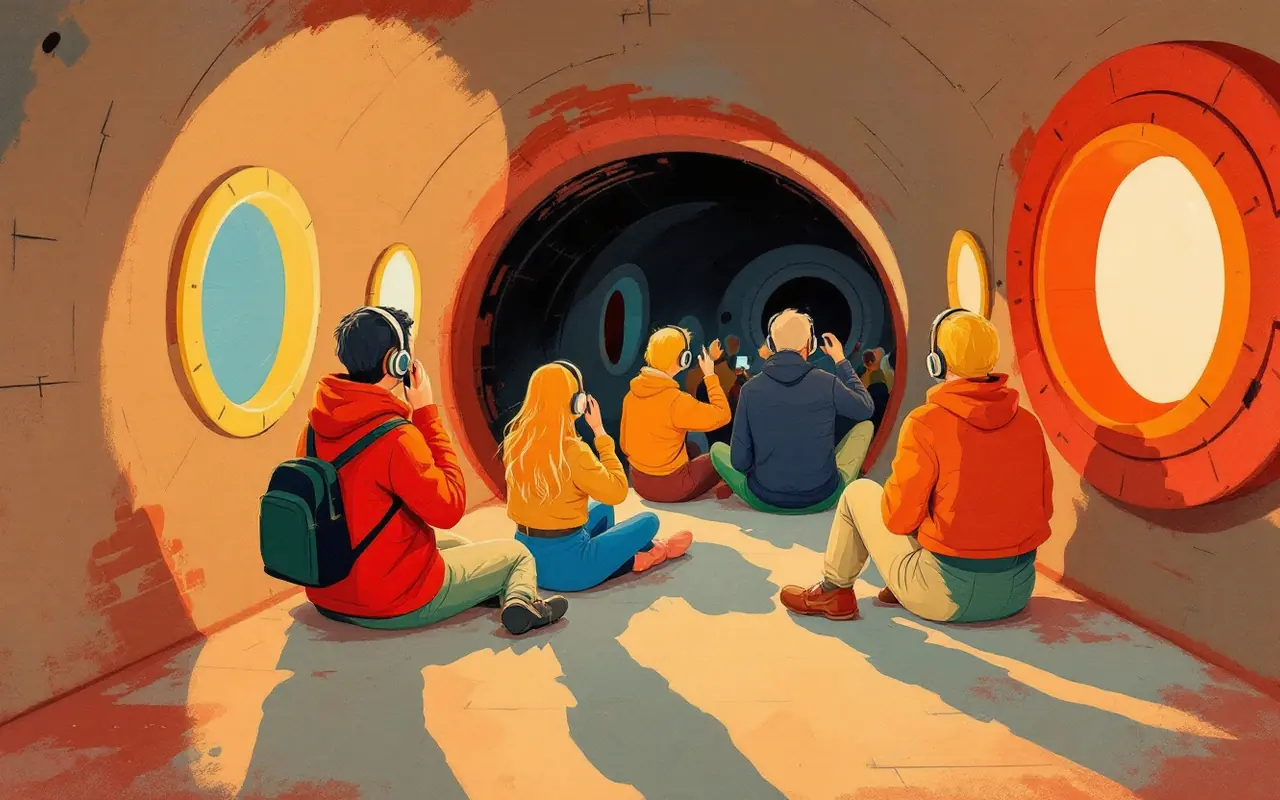
A language is a difficult thing to put behind glass. It makes no dust, it has no shape, and the moment you pin it to a label it stops moving. The few museums that try are therefore run by stubborn people, and stubborn people make good museums.
This guide describes places whose subject is language or writing itself, followed by collections that are not about language but where learners of Arabic and Hebrew will find something to read. Opening days change, so each entry links to the museum's own site and gives no hours. We describe what the institutions say about themselves and what their collections contain; plan with their current pages in hand.
Mundolingua, Paris
Behind the church of Saint-Sulpice, in a narrow street, Mundolingua calls itself a museum of languages, language and linguistics. It opened in October 2013, the project of Mark Oremland, a New Zealander who studied linguistics in Paris, and it spreads over a ground floor and a cellar.
The method is touch and headphones. Screens carry short lessons, drawers open, games wait on tables. One exhibit on the ground floor is a large model of a head: press a phonetic symbol, listen to the sound, and see the place in the mouth where it is made.
For a learner of Arabic or Hebrew that head is the reason to go. The sounds that frighten beginners, ḥ, ʿ, q, are simply places further back than English ever goes. Seeing them light up on a map of the throat does what a paragraph cannot. Bring a list of your five worst sounds.
The museum of the world's scripts, Figeac
In the south-west of France, the birthplace of Jean-François Champollion, who read the hieroglyphs, holds a museum devoted to the writing systems of the world. Its own summary promises a thousand square metres on the birth and history of writing.
Go for the long view. Our two alphabets are late descendants in a story that starts with clay tokens and pictures, and between the pictures and the alphabet stands the small revolution that Semitic speakers in the Sinai and the Levant brought about when they used a drawing of an ox for the first sound of their word for ox. The letter is alef in Hebrew and alif in Arabic. Turn a capital A upside down and the horns are still there.
Planet Word, Washington
Planet Word, in the historic Franklin School, describes itself as the world's first voice-activated museum. Its galleries ask visitors to speak, sing and argue rather than look. English is at the centre but the rooms about the world's languages and about how babies learn to talk are useful to anyone who is, at fifty, trying to do it again.
The Canadian Language Museum, Toronto
Small, serious and generous with its material, the Canadian Language Museum works to promote an appreciation of all the languages used in Canada, from Indigenous languages to those of recent arrivals. Besides its permanent place in Toronto it sends travelling exhibits around the country, and several can be explored online. It is the best answer we know to the question of what a museum can do for a language that has no paintings and no temples.
The Museum of the Portuguese Language, São Paulo
Housed in a railway station that saw millions of immigrants arrive, the Museu da Língua Portuguesa tells the story of one language as a river with many tributaries. One of them is Arabic. Portuguese took hundreds of words from it during the centuries of al-Andalus, many still wearing the article al- like a forgotten name tag. The English, French and Spanish cousins of the same words are سُكَّر (sukkar, “sugar”), قُطْن (quṭn, “cotton”) and لَيْمُون (laymūn, “lemons”).
The Esperanto Museum, Vienna
Part of the Austrian National Library, the Esperanto Museum is about planned languages of all kinds. It belongs on this list for a quiet reason. Every inventor of a language has to decide what to leave out, and walking among their decisions makes you look at your own two languages with fresh eyes. Why do Arabic and Hebrew both need gender on the verb? Why did one keep its dual and the other let it go?
Museums where Arabic and Hebrew share a room
Paris again. The Institut du monde arabe has a museum, a library, a bookshop and a full calendar of concerts and talks; its language centre teaches Arabic. A walk away across the river, the mahJ shows Jewish art and history, including objects from North Africa on which Hebrew and Arabic stand side by side. Doing both in a day makes a good lesson in one pattern: the same ornamental frames, different letters inside.
Marrakech. In the Jardin Majorelle, the Pierre Bergé museum of Berber arts shows jewellery, textiles, tools and household pieces from across Morocco's Amazigh regions. It is not a language museum, but the third language of the country is in every room, and so is its script, Tifinagh. Amazigh belongs to the wider Afroasiatic family and so is a distant relative of both our languages. Jewish silversmiths made a share of such jewellery, which is one of the reasons the subject interests readers of this site.
Casablanca. The Museum of Moroccan Judaism is devoted to Jewish life in Morocco, with ritual objects, costumes, jewellery, photographs and reconstructed synagogues. Look at inscriptions on textiles and metal, where the Hebrew often carries an Arabic family name or a Judeo-Arabic blessing.
Essaouira. In the old town, Bayt Dakira, the house of memory, was opened in 2020 in a restored house with a synagogue inside. Its name is itself a small vocabulary lesson: بَيْت (bayt, “house”) plus a word from the root of remembering, the one that gives Arabic ذَكَرَ (dhakara, “he mentioned, remembered”) and Hebrew זָכַר (zakhar, “he remembered”).
Libraries that let you look
Not everything needs a ticket. The Cambridge Digital Library shows Genizah fragments in close-up, and the Princeton Geniza Project explains many of them. For the pages where Arabic is written with Hebrew letters, read our introduction to Judeo-Arabic first, then pick a school exercise or a letter and see how far you get.
How to visit a language museum when you are learning one
Most visitors drift from screen to screen and come out with a headache. A learner can do better with a little preparation.
Bring one question per room. Not a general interest, a question: how do other languages mark plural? What does a script with no letters for vowels look like in other families?
Use your ears first. Put the headphones on before you read the panel. Guess what you are hearing, the family, the region, the number of consonants that sound new. Then read.
Copy something by hand. A row of letters you cannot read, a word you like. Five minutes of copying an unknown script will remind you how your own two looked in the first week, and will make you kinder to yourself.
Talk to the staff. In small museums the person at the desk is often a linguist or a polyglot, and delighted to be asked.
Leave after ninety minutes. Language is tiring to look at. Go and sit in a café and try to overhear something.
If you cannot travel
Make a museum shelf at home. It needs five objects, and it costs little. A coin or banknote with Arabic on it. A bilingual food packet. A page of handwriting by somebody you know. A children's book in each language. A printed photograph of one inscription that you intend to be able to read by the end of the year. Put a label under each, in both scripts, with the vowel marks. Change one object a month.
The labels are the point. Writing six words that will be looked at every day, by you and by visitors who ask, is better practice than sixty in a notebook. Use our alphabet chart for the letters and the roots table to find words that belong together.
A short list of words for museum days
| Meaning | Arabic | Hebrew |
|---|---|---|
| language | لُغَة lugha | שָׂפָה safa |
| letter | حَرْف ḥarf | אוֹת ot |
| word | كَلِمَة kalima | מִלָּה mila |
| book | كِتَاب kitāb | סֵפֶר sefer |
| pen | قَلَم qalam | עֵט ʿet |
| new | جَدِيد jadīd | חָדָשׁ ḥadash |
| year | سَنَة sana | שָׁנָה shana |
| thank you | شُكْرًا shukran | תּוֹדָה toda |
Say the last row to the person at the desk. It is the only sentence in this guide that works in every museum on the list.
Read alongside
Judeo-Arabic: Arabic in Hebrew letters, and why it matters to learners
For more than a thousand years people wrote Arabic with the Hebrew alphabet. A short history, the spelling, and where to look at it today.
Marguerite Dourlens, 25 Nov. 2026